Football betting sites offer a wide range of markets, but attractive odds do not always represent a genuine opportunity. Prices can change because of injuries, team news, betting volume, tactical expectations or ordinary market correction. Understanding those movements is more useful than assuming every unusual line is a deliberate “trap”.
A careful staker should therefore study team statistics, confirmed line-ups and responsible bankroll rules. The goal is not to predict every result, but to make decisions based on evidence and avoid unnecessary exposure.
What “lure bets” mean
The phrase “lure bet” is commonly used by bettors to describe a market that appears unusually attractive but may carry more risk than its surface price suggests. It is not proof that a bookmaker has manipulated a match or created a guaranteed losing selection.
Bookmakers set prices to reflect their assessment of probability while also accounting for margin and market demand. They may adjust odds when large amounts of money arrive on one side or when new information changes the expected outcome.
A seemingly appealing price may result from:
- Uncertainty over an injured or rested player.
- A late change to the starting line-up.
- Public enthusiasm for a famous team.
- A tactical matchup that is not obvious from league positions.
- A correction after the opening odds attracted too much money.
- Different risk assessments among bookmakers.
This is why bettors should treat football betting odds as information, not as a promise of profit.
Why inexperienced bettors lose
New bettors often focus on a team’s reputation, recent scoreline or a high payout while ignoring the wider context. A strong club can still struggle against a disciplined low-block opponent, particularly when it is missing its main creator or playing after a demanding fixture.
Another common mistake is confusing low odds with certainty. A selection priced at 1.30 may be considered more likely than one priced at 3.50, but it can still lose. Odds also include a bookmaker’s margin, meaning the combined implied probabilities in a market can exceed 100 percent.
Emotional betting creates further problems. Supporters may back their favourite club, chase a previous loss or increase their stake after seeing other bettors promote a selection. These decisions turn a football analysis task into an impulse-driven transaction.
Signs that require investigation
Unusual market movement should encourage further research rather than automatic opposition to the selection. The following situations deserve attention:
A handicap moves against the favourite
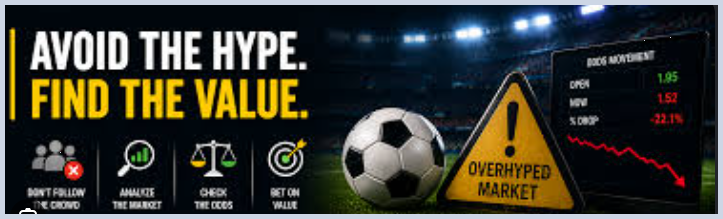
If a strong home team opens at -1 and later moves to -0.75, the market may be expressing greater uncertainty about its ability to win comfortably. Possible reasons include an injury, rotation, poor weather, a tactical concern or professional money supporting the underdog.
The movement itself does not reveal the cause. Check team news, press conferences and confirmed line-ups before drawing a conclusion.
Asian handicap lines apply a virtual advantage or deficit to the final score. For example, a -0.5 selection must win, while a +0.5 selection succeeds if the team wins or draws. Whole-goal and quarter-goal lines can produce refunds or partial settlements, so the rules must be understood before betting.
The price looks too generous
A high payout on a supposedly safe option may appear attractive, but it can also indicate that the market has identified hidden uncertainty. Check whether the selection is genuinely supported by recent performances, squad availability and tactical conditions.
Do not assume that an inflated price is automatically “value”. Value exists only when your estimated probability is higher than the probability implied by the odds after considering the bookmaker’s margin.
Several operators move together
A price change at one operator may be a routine adjustment. Similar movement across several reputable bookmakers is more likely to reflect shared information, market demand or a significant team-news development.
Even then, the movement should not be treated as a guarantee. Research the reason and decide whether the current price still matches your assessment.
Use analysis, not reverse psychology
Some bettors respond to suspicious odds by automatically backing the opposite side. That approach can be just as dangerous as following the crowd. A market may move against a favourite because the team is genuinely weaker than expected, not because the bookmaker is trying to mislead customers.
A more reliable process is to ask:
- What has changed since the opening line?
- Is a key player unavailable or being rested?
- Does the tactical matchup favour the underdog?
- Are the recent results supported by strong performances?
- Has the market moved because of verified information or speculation?
- Is the current price still acceptable after the adjustment?
Research should include recent home and away form, goals scored and conceded, expected line-ups, injuries, suspensions, travel demands and weather. Head-to-head records can provide background, but older meetings should not outweigh current team conditions.
Making better decisions
A football betting site can provide prices, markets and statistics, but it cannot remove uncertainty from sport. The strongest process combines analysis, tactical research, line-up checks and disciplined money management.
Avoid labelling every unexpected price as a bookmaker trick. Instead, identify what the movement may be communicating, test that explanation against reliable evidence and walk away when the information is unclear. Skipping a confusing match is often a better decision than forcing a wager.