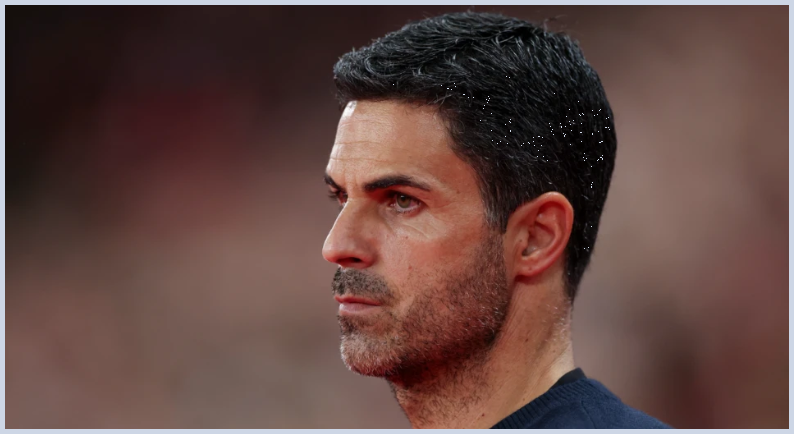
Mikel Arteta has rebuilt Arsenal several times since arriving in 2019, and the champions’ heavy defeat at Brighton has raised fresh questions about the direction of his latest experiment. Arsenal were beaten 3-0 at the Amex Stadium in their final match before the international break, ending a perfect start to their Premier League title defence.
Brighton, under Fabian Hurzeler, refused to sit deep and instead pressed Arsenal aggressively, forcing repeated mistakes in possession. Arteta admitted his side were “in trouble” from the first throw-in and said the biggest lesson was the need to play out of pressure much faster.
Arteta’s Evolving Arsenal
Arteta’s Arsenal have changed significantly since he took charge. His early teams were more defensively structured and pragmatic, exemplified by the FA Cup triumph in his first season, before evolving into a more fluid attacking side and later into a controlled, physically dominant unit.
Having finally won the Premier League, Arteta appears willing to take greater risks with personnel and tactics. That ambition can produce more dominant performances, but it also increases the possibility of heavy defeats when execution drops.
The Brighton result was a reminder that tactical innovation carries a cost. Arsenal had won every league game before that defeat, yet the manner of the loss suggested their new approach still needs refinement.
Arsenal’s New 3-1-6 Shape
Last season, Arsenal’s midfield was built around Martin Zubimendi at the base, with Declan Rice operating in a more advanced, box-to-box role. The surprise use of Myles Lewis-Skelly as a holding midfielder later helped restore momentum as Arsenal pushed for the title.
This season, Arteta has used a 3-1-6 structure in possession. Rice drops deeper rather than pushing forward, joining Ezri Konsa and Gabriel Magalhaes to form a back three, while Lewis-Skelly operates as the lone pivot connecting defence and attack.
The rest of the team is not simply a conventional front six. Riccardo Calafiori, Ben White and Martin Odegaard can all drop into deeper areas at different moments, turning Arsenal’s base into either a 3-2 or 4-1 shape. Those movements are designed to create numerical advantages, help Arsenal play through opponents and progress the ball more effectively.
With William Saliba unavailable, Konsa offers composure and ball-playing ability in defence. Rice, meanwhile, has the passing range and carrying quality to thrive when facing forward, reducing the time he spends receiving the ball with his back to goal in tight areas.
Lewis-Skelly’s Importance
Lewis-Skelly has made the pivot role his own because of his composure under pressure, strength in possession, ability to beat opponents one-v-one and willingness to take risks in build-up play. His confidence on the ball is central to Arsenal’s attempt to play through a high press.
England manager Thomas Tuchel has also taken notice. During the international break, England used a similar structure, with Elliot Anderson taking on the deeper role that Rice performs for Arsenal, while Lewis-Skelly was used further forward in midfield.
That growing influence underlines why his absence from the Brighton starting XI mattered. Bruno Guimaraes filled the holding midfield position instead, but he did not have the same familiarity with the demands of Arteta’s system.
How Brighton Exposed the System
Brighton’s high-intensity pressing, both with and without the ball, made it difficult for Arsenal to establish their usual control. Playing through such a press requires precise technique, intelligent positioning, well-timed movement and a strong understanding between teammates.
Guimaraes was asked to operate in the holding role against an aggressive man-to-man press, a demanding assignment given his limited time in that specific function. Brighton’s pressure forced Arsenal into hesitant passing, rushed decisions and uncharacteristic technical errors.
Even when Brighton dropped into a deeper defensive block, they did not simply allow Arsenal to dominate possession. Hurzeler’s side repeatedly sprang into a man-to-man press from their settled shape, denying Arsenal easy passing options and preventing them from settling into their preferred rhythm.
Arteta was clear about the problem. “You could see from the first throw-in, it was so clear. We put ourselves in trouble one, two, three times,” he said. “We need to get out much quicker than that, and that’s one of the biggest lessons we have to take from the game today.”
Can Others Copy Brighton?
Brighton’s victory may encourage other Premier League sides to press Arsenal in a similar way. The champions’ new system depends heavily on clean ball progression, intelligent rotations and players being comfortable receiving under pressure.
However, copying Brighton is not straightforward. It requires an intense pressing structure, excellent physical conditioning and the courage to attack Arsenal rather than simply defend deep. Few teams have Brighton’s clarity of identity or ability to sustain that approach for 90 minutes.
Arsenal’s response will be crucial. Arteta can adjust personnel, restore Lewis-Skelly to the pivot role, simplify certain build-up patterns or retain the system while improving its execution.
A Necessary Gamble
The defeat was damaging, but it does not necessarily invalidate Arteta’s broader plan. Arsenal is attempting to evolve because rivals are closing the gap, and a side that refuses to adapt can quickly become predictable.
The challenge is to balance ambition with reliability. Arsenal’s new approach offers greater attacking variety and positional flexibility, but Brighton showed that it can be dismantled when the press is intense and the pivot lacks rhythm.
For a club aiming to remain at the summit of English football, standing still may be the bigger risk. Arteta’s willingness to reinvent Arsenal could define the next stage of their project—provided the lessons from Brighton are quickly absorbed.