Manchester City’s four consecutive League Cup victories from 2018 to 2021 are widely remembered. However, another English club achieved a Wembley treble before Pep Guardiola’s side.
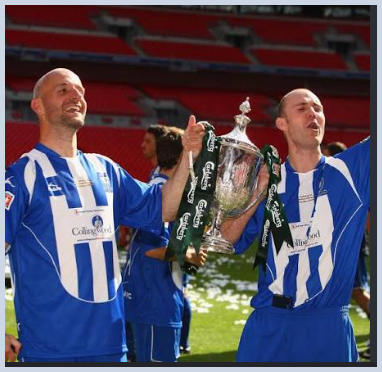
Whitley Bay, a ninth-tier team from the Northern League, won three successive FA Vase finals between 2009 and 2011. No other non-league club had previously completed that sequence, and the achievement remains one of the greatest stories in amateur football.
The FA Vase was established in 1974 for amateur clubs. More than five decades later, Whitley Bay remains the competition’s only four-time winners, with their three consecutive triumphs forming the centrepiece of the club’s history.
Their success was guided by Ian Chandler, an IT manager from Sunderland who had already played for Whitley Bay during three separate spells. He became manager in 2004 and remained in charge for a decade.
Planning success between work
Chandler’s managerial methods were unusual because he had to balance football with a full-time job. He often used quiet periods during the working day to arrange team travel, book hotels and study opponents.
The foundations for Whitley Bay’s remarkable run were laid after a painful FA Vase exit in 2008. The team lost the first leg of their semi-final against Lowestoft Town 4-0. They responded by taking a 3-0 lead in the return match at Hillheads Park but could not complete the comeback.
Chandler later developed a superstition about avoiding pre-match interviews because the last interview he had given came before that heavy first-leg defeat.
The disappointment strengthened the squad’s resolve. Players who had attracted attention from higher-level clubs decided to remain and attempt to finish the job.
“The hardest thing is keeping a successful team together because players quickly get noticed and move up,” Chandler explained. “After the semi-final, the players wanted to stay and prove themselves. Then they wanted to do it again.”
And then once more.
Football inspired by Newcastle
Although Chandler is a lifelong Sunderland supporter, he modelled Whitley Bay’s approach partly on Kevin Keegan’s Newcastle United.
The priority was not simply to win but to entertain. Chandler was willing to take attacking risks, sometimes leaving only two defenders behind when the team needed a goal.
“There was always a joke about whether we would play with two or three at the back,” he said. “Supporters want entertainment, and that was what we tried to provide.”
Chandler already had legendary status at Whitley Bay before becoming manager. He scored the winning goal in the club’s 2002 FA Vase final against Tiptree United at Villa Park.
Chairman Paul McIlduff said Chandler eventually built a side combining speed, creativity and a strong dressing-room mentality.
“We had quick players on the wings, an excellent midfield and strikers who knew how to finish,” McIlduff said. “The important thing was bringing in players who fitted the character of the group. Nobody acted as though they were more important than anyone else.”
The ‘Whitley Bay Maradona’
One of the team’s most influential players was Paul Robinson, who became known locally as the “Whitley Bay Maradona”.
Robinson had been part of Newcastle United’s academy and later played for several non-league clubs in the north-east. He joined Whitley Bay in 2007 and stayed until 2013.
He also worked at software company Sage, where Chandler was his manager away from football.
“He was my manager at work and my manager in football, so I was probably tired of seeing him,” Robinson joked. “But it did help when I needed time off for matches.”
Robinson admitted that his thoughts frequently drifted towards football while he was at work. He would imagine scoring, winning and facing opponents before important matches.
His defining moment came in the second leg of the 2010 semi-final against Barwell. With the tie level and heavy rain falling, Robinson scored a late diving header to secure a 6-5 aggregate victory. The goal triggered a pitch invasion and sent Whitley Bay back to Wembley.
Robinson believes those semi-final and quarter-final matches were sometimes more significant than the finals themselves. Hillheads Park regularly attracted crowds of 2,000 to 3,000, allowing amateur players to experience an atmosphere normally associated with professional football.
Growing fear among opponents
Whitley Bay’s previous FA Cup success also prepared the squad for high-pressure matches. Chandler had played in the team that defeated Preston in the second round of the 1989-90 FA Cup before reaching the third round for the only time in the club’s history. Whitley Bay reached the second round again the following season.
By the time of their FA Vase treble, the club had developed a reputation that intimidated opponents.
Robinson recalled one quarter-final against Biggleswade in 2009, when the visiting players arrived wearing suits and ties.
“They treated it like their cup final,” he said. “We beat them 5-2. Eventually, teams arrived already afraid of us.”
A town united by football
The success transformed Whitley Bay, a working-class coastal town near Newcastle with a long history as a holiday destination.
Local volunteers worked tirelessly to support the club. They visited businesses in Whitley Bay, Tynemouth and North Shields, encouraged sponsorship and helped sell tickets. A van was even stationed outside Woolworths on the high street.
Jenn Robinson became involved through her late husband, Mike, who served on the club’s board.
“Every shop had blue-and-white decorations,” she recalled. “There was excitement everywhere, and local businesses wanted to help.”
Newcastle United assisted with ticket sales, while North Tyneside Council provided security for the crowds gathering at Hillheads Park.
Travel arrangements for the Wembley finals were not always straightforward. The club organised trains for supporters, but one service stopped at King’s Cross instead of travelling directly to Wembley, forcing officials to arrange taxis.
Despite the problems, the Whitley Bay support made it to the national stadium three years in a row.
Three Wembley triumphs
Whitley Bay defeated Glossop North End 2-0 in the 2009 final in front of 12,200 spectators. They returned in 2010 and produced an even more emphatic performance, beating Wroxham 6-1.
Paul Chow scored after only 21 seconds, setting what was then a record for the fastest goal in a Wembley final. That record survived for 13 years before Manchester City’s Ilkay Gundogan scored after 13 seconds in the 2023 FA Cup final.
The treble was completed in 2011 with a thrilling 3-2 victory over Coalville Town. Coalville twice fought back to equalise, but Chow scored again in the 86th minute to settle the final.
Almost 30,000 supporters attended the three matches combined. After each victory, the team celebrated at The Green Man pub, around 15 minutes from Wembley.
The 2010 celebrations were particularly memorable. The squad spent 10 days together, preparing for the final before travelling to Marbella. The players and their families later gathered for a celebration near the stadium.
A special moment for Mark Taylor
The 2010 trophy lift also carried deep emotional significance because former teammate Mark Taylor joined the celebrations.
Taylor had played in the 2009 final but was diagnosed with motor neurone disease soon afterwards, ending his career prematurely. He continued travelling with the team and remained close to the squad.
“He just wanted to be Mark, and we had a laugh wherever we went,” Chandler said. “He was central to what we achieved in the second and third seasons.”
A golden era remembered
Whitley Bay’s success attracted national attention. Journalists visited Sage to interview Chandler and his players, while members of their families also appeared on local radio.
Chandler was invited to major sporting events alongside famous managers such as Sir Alex Ferguson and Sven-Göran Eriksson. Robinson, meanwhile, found returning to office life after Wembley difficult.
“One year I received a standing ovation when I entered the office,” he recalled. “After that, it went back to normal, and people would joke, ‘Are you still talking about Wembley?’”
Chandler left Whitley Bay in 2014 after a decline in form. The club have not won another major trophy since the 2011 FA Vase and remain in the ninth tier.
Yet their remarkable achievement has not been forgotten. In the north-east, where football is deeply embedded in local culture, people still remember the part-time players who turned Whitley Bay into a national cup powerhouse.