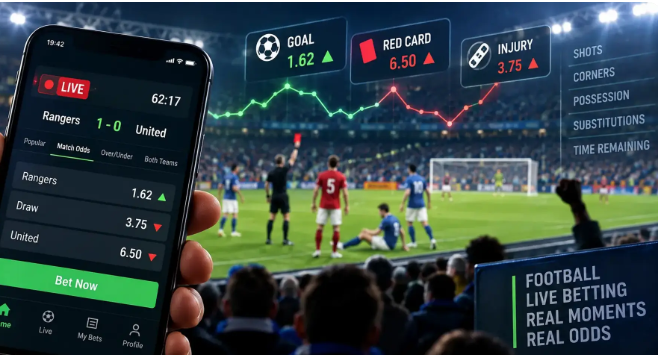
Imagine checking the odds for an important football match in the morning and noticing that they look different when you return in the afternoon. A team that was previously priced at 2.10 may now be available at 1.85, while its opponent's odds have increased. Nothing has happened on the pitch, so what explains the difference?
This situation is common in football betting. Football betting odds change before kick-off because bookmakers constantly review information, assess risks and respond to betting activity in the market. These adjustments can happen several times before a referee blows the opening whistle.
Understanding why these movements occur can help football fans interpret the market more carefully instead of assuming that every change signals a guaranteed result.
Why Football Betting Odds Change Before Kick-Off
1. New Team News Can Influence the Odds
One of the biggest reasons football betting odds change before kick-off is the release of important team information.
Before a match, supporters and analysts may not know whether certain players will be available. A club could be dealing with an injury concern involving its leading striker, an influential midfielder or an experienced defender. Once the manager confirms the team news, bookmakers may adjust their prices.
For example, if a club's main goalscorer is ruled out shortly before a match, its chances of winning may be reassessed. The odds on that team could increase because its attacking strength has been affected.
The opposite can also happen. If an important player returns from injury or is confirmed in the starting line-up, the team's odds may shorten.
This is why checking football team news before kick-off is useful. However, fans should remember that the importance of an absent player depends on the available replacements, tactical approach and overall squad depth.
2. Betting Activity Can Move the Market
Another major factor is the amount of money being placed on different outcomes. Bookmakers monitor betting patterns and may adjust their odds when they receive significant activity on one particular selection. If many customers back the home team, its price may shorten while the odds on the away team or draw increase.
This does not automatically mean the home side has become stronger. It may simply indicate that more money is being placed on that outcome. For instance, a home win initially offered at 2.20 could move to 2.00 after considerable betting interest. The change reflects how the bookmaker is managing its exposure and responding to the market.
This explains why football betting odds movement should not be confused with a confirmed prediction. A popular selection is not necessarily the most likely winner.
3. Important Match Information Can Change Expectations
Football matches are influenced by more than the names of the players available. Other developments can also affect how bookmakers assess a fixture.
A manager might announce that several first-team players will be rested because of a demanding schedule. A club could be dealing with internal disciplinary issues, while another may have recently changed its tactical approach.
Information about weather conditions, pitch quality and possible travel difficulties can also influence expectations, particularly when these factors are likely to affect how a team performs.
Consider a side that depends heavily on quick passing and movement. If poor weather is expected to make the playing surface difficult, its attacking approach could become less effective. When such information becomes available, bookmakers may review the prices attached to the match.
4. Odds Shortening and Odds Lengthening Have Different Meanings
Understanding the language used in betting markets is important when following price movements. When odds shorten, the price offered on a particular outcome becomes smaller. For example, a team moving from 2.50 to 2.10 has experienced a shortening of its odds.
When odds lengthen, the price becomes bigger. A movement from 1.90 to 2.20 is an example. Generally, shortening odds indicate that the market has assigned a higher implied probability to an outcome, while lengthening odds indicate a lower implied probability.
However, these movements should not be treated as proof that a particular result will happen. Odds reflect market assessments and bookmaker pricing, not certainty.
A team whose odds shorten can still lose, just as a team with lengthening odds can produce an unexpected victory.
5. Different Bookmakers May Offer Different Odds
Football fans sometimes notice that the same match has different prices across several betting platforms. This is not unusual.
Each bookmaker has its own pricing methods, risk-management approach and customer betting patterns. One operator may receive significant support for the home team, while another may experience more activity on the away side.
As a result, their odds may not move at exactly the same time or by the same amount. For example, one bookmaker might reduce a team's winning odds from 2.40 to 2.15, while another still offers 2.30. These differences can occur because operators do not always assess new information or betting activity identically.
Comparing prices can help fans understand how the market is developing. It also shows why relying on a single bookmaker's odds may provide an incomplete picture.
6. Late Changes to the Starting Line-Up Can Cause Sudden Movements
Although team news is often released before kick-off, the final starting line-up can still produce unexpected reactions.
A manager may leave a regular starter on the bench, introduce an unfamiliar combination in midfield or make several changes after an important European fixture.
These decisions can influence how the market views a team's chances. Imagine a club that has won its previous three matches with a consistent starting eleven. If the manager unexpectedly rests two key attackers, bookmakers may reassess the team's attacking potential.
Late injury concerns during the warm-up can also lead to sudden adjustments. This is why the final team sheet is worth checking before drawing conclusions about a match. An early price may have been calculated using assumptions that no longer apply.
7. What Changing Odds Do Not Tell You
One common mistake among football fans is assuming that a major odds movement must be connected to secret information or a guaranteed outcome.
That conclusion is not always justified. A price can change because of betting volume, updated information, a bookmaker's internal risk management or adjustments made elsewhere in the market. Sometimes, several factors contribute to the same movement.
Furthermore, odds do not explain every detail about a football match. They cannot fully capture the atmosphere in a stadium, an unexpected tactical decision or the impact of an early red card. Fans should therefore avoid making decisions based entirely on whether a team's price has shortened or lengthened.
A better approach is to consider the team's recent performances, injuries, head-to-head context, tactical strengths and likely starting line-up alongside the odds.
8. How Football Fans Should Interpret Pre-Match Odds Changes
The most useful way to follow pre-match betting odds changes is to treat them as additional information rather than instructions. First, compare the opening price with the latest available price. This helps you identify the direction and size of the movement.
Next, look for a reasonable explanation. Has an important player been ruled out? Has the manager confirmed several changes? Is there a noticeable difference in betting activity? It is also helpful to compare prices across different bookmakers rather than assuming that one operator represents the entire market.
Most importantly, remember that a shorter price does not automatically represent better value. A selection can become less attractive when its odds fall, even if the market considers it more likely to win.
Fans should also avoid chasing every sudden movement. Not every price adjustment deserves a reaction, and there is no guarantee that following market changes will produce a successful outcome.
Conclusion
Football betting odds change before kick-off for several reasons, including injuries, team selection, new information, betting activity and bookmaker risk management. These adjustments are part of how betting markets respond to developments surrounding a fixture.
For football fans, the important lesson is to understand what the movement represents before attaching too much meaning to it. Odds can offer useful insight into market expectations, but they cannot guarantee what will happen during the 90 minutes.
By combining price movements with proper football analysis, supporters can develop a clearer understanding of how pre-match markets work and why the numbers sometimes change just hours before kick-off.