Not every football match is expected to be a close contest. Sometimes, one team enters a fixture with a stronger squad, better recent performances and a clear advantage over its opponent. In other situations, the difference between the sides is much smaller, making the outcome harder to assess.
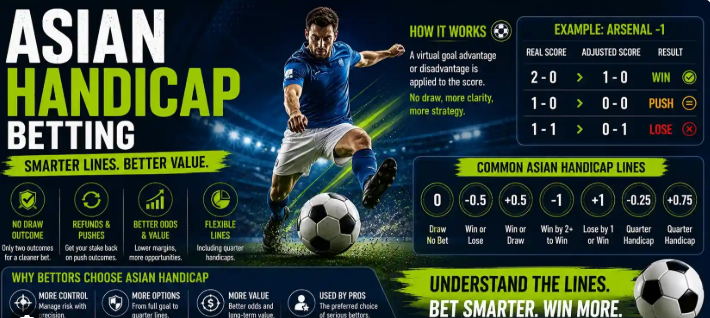
This is where the Asian handicap market becomes interesting. Instead of simply asking which team will win, it introduces a virtual goal advantage or disadvantage to reflect the expected difference between the two sides.
For football fans who want to understand how betting markets assess team strength, Asian handicap lines provide an interesting way to examine match expectations. They offer more detail than ordinary win-or-draw prices because they indicate how convincing a bookmaker expects a team's performance to be.
What Is the Asian Handicap Market?
The Asian handicap is a football betting market that gives one team a virtual advantage or disadvantage before the match begins. This adjustment is designed to make the contest more balanced from a betting perspective.
For example, imagine a match between a leading club and a team struggling near the bottom of the table. The stronger side may be given a -1 handicap, while its opponent receives a +1 handicap.
In this situation, the stronger team must win by at least two goals for a -1 selection to produce a full win. If it wins by exactly one goal, the stake is returned under a standard whole-goal handicap.
The weaker team, meanwhile, benefits from the virtual goal advantage. It can lose by one goal and still produce a winning outcome on a +1 selection through the adjusted score. This structure helps explain how the market accounts for differences in team quality rather than focusing only on the final winner.
Handicap Lines Reflect the Expected Strength Gap
One of the most important things Asian handicap markets communicate is how far apart two teams are considered to be before kick-off.
A small handicap, such as -0.25 or -0.5, generally indicates that the market sees a relatively narrow difference between the sides. The favourite may have an advantage, but the opponent is not expected to be completely outmatched. A larger line, such as -1.5 or -2, suggests a stronger expectation that one team could dominate the contest.
Consider a hypothetical match between an established league leader and a newly promoted club. If the stronger side receives a -1.5 handicap, the market is reflecting an expectation of a significant performance gap.
However, this does not mean the favourite will automatically win comfortably. Handicap lines represent market expectations, not guaranteed scorelines.
Understanding Negative and Positive Handicaps
The signs attached to Asian handicap selections are essential for understanding how the market works. A negative handicap is assigned to the team considered stronger. It means that the team must overcome a virtual disadvantage when the result is assessed.
A positive handicap is given to the side expected to be weaker. It provides that team with a virtual goal advantage before the actual score is considered. For example, with a -0.5 handicap, the selected team must win the match. A draw or defeat results in a losing selection.
With a +0.5 handicap, the selected team can either win or draw for the selection to succeed. These adjustments make it easier to understand why two teams can have different handicap prices even when the ordinary match odds appear relatively straightforward.
Quarter-Goal Handicaps Reveal Smaller Differences
Asian handicap markets also use quarter-goal lines, including -0.25, +0.25, -0.75 and +0.75. These are particularly useful when the expected difference between teams is not large enough to justify a full or half-goal handicap.
A quarter-goal handicap divides the stake into two equal parts across the neighbouring handicap lines. For instance, a -0.25 selection is split between 0 and -0.5. If the match ends in a draw, the portion placed on the 0 handicap is returned, while the portion on -0.5 loses.
Similarly, a +0.25 selection is divided between 0 and +0.5. A draw produces a half-win because the first portion is refunded and the second portion wins. This arrangement allows the market to express smaller differences in expected team strength without forcing every match into a simple win-or-lose assessment.
Recent Form Can Influence the Handicap
A team's reputation does not always determine its handicap. Bookmakers also consider current performances when assessing how two sides compare.
A traditionally successful club may receive a smaller handicap than expected if it has struggled in recent matches. Poor defending, injuries, disappointing away performances and a lack of goals can all influence its market position.
Meanwhile, a less famous opponent enjoying a strong run may be considered more competitive than its league position suggests. Imagine a top-four club preparing to face a mid-table opponent that has won four of its last five matches. The stronger club may still be the favourite, but the handicap could be smaller because the opponent's recent performances suggest that the gap is not particularly wide.
This demonstrates why Asian handicap analysis should involve more than looking at league positions or club reputation.
Home Advantage and Away Performance Matter
Playing at home can influence how bookmakers assess the difference between two football teams. Some clubs are significantly more dangerous in front of their supporters. They may press aggressively, create more chances and defend with greater confidence on familiar ground. Other teams perform better away from home, particularly those that are comfortable defending deep and attacking through quick counter-attacks.
These differences can affect the handicap line. For example, a strong club facing a difficult away fixture may receive a smaller negative handicap than it would at home against the same opponent.
The adjustment reflects the possibility that the home side could make the contest more competitive. It does not necessarily mean the away team has become weaker.
Squad Quality and Tactical Match-Ups Also Matter
The difference between two teams cannot always be measured by comparing their starting players individually. Tactical organisation, squad depth and playing style can determine how effectively one side handles another.
A team with technically gifted midfielders may struggle against an opponent that presses intensely and prevents it from building attacks. Similarly, a defensively organised side can frustrate a stronger opponent that relies heavily on possession.
Injuries and suspensions can also change the expected balance. Losing a central defender, creative midfielder or leading striker may reduce a team's ability to control the match.
For this reason, handicap movements should be considered alongside team news and tactical information. A seemingly small change in the handicap may reflect an important development affecting the expected strength of either side.
What Handicap Markets Cannot Guarantee
Although Asian handicap lines offer useful information, they should not be treated as exact measurements of team quality. Football is unpredictable. An early red card, a defensive mistake, a penalty or an unexpected tactical decision can completely change a match.
A team given a -1.5 handicap may dominate possession but struggle to convert its chances. Another side receiving +1.5 may defend effectively and produce a surprising result. It is also important to remember that different bookmakers can offer different handicap lines and prices. These differences reflect their individual assessments and market conditions.
Fans should therefore use handicap information as one part of wider football analysis rather than relying on it alone.
Conclusion
Asian handicap markets provide a useful way to understand how bookmakers assess differences in strength between football teams. The size of the handicap, whether it is positive or negative, and how the line changes can reveal how competitive a fixture is expected to be.
However, these markets do not predict the exact score or guarantee that a stronger team will dominate. Recent form, home advantage, squad availability and tactical match-ups all contribute to the bigger picture.
For football fans, understanding Asian handicap lines makes it easier to interpret pre-match expectations and recognise why some teams are considered much stronger than their opponents before kick-off.